

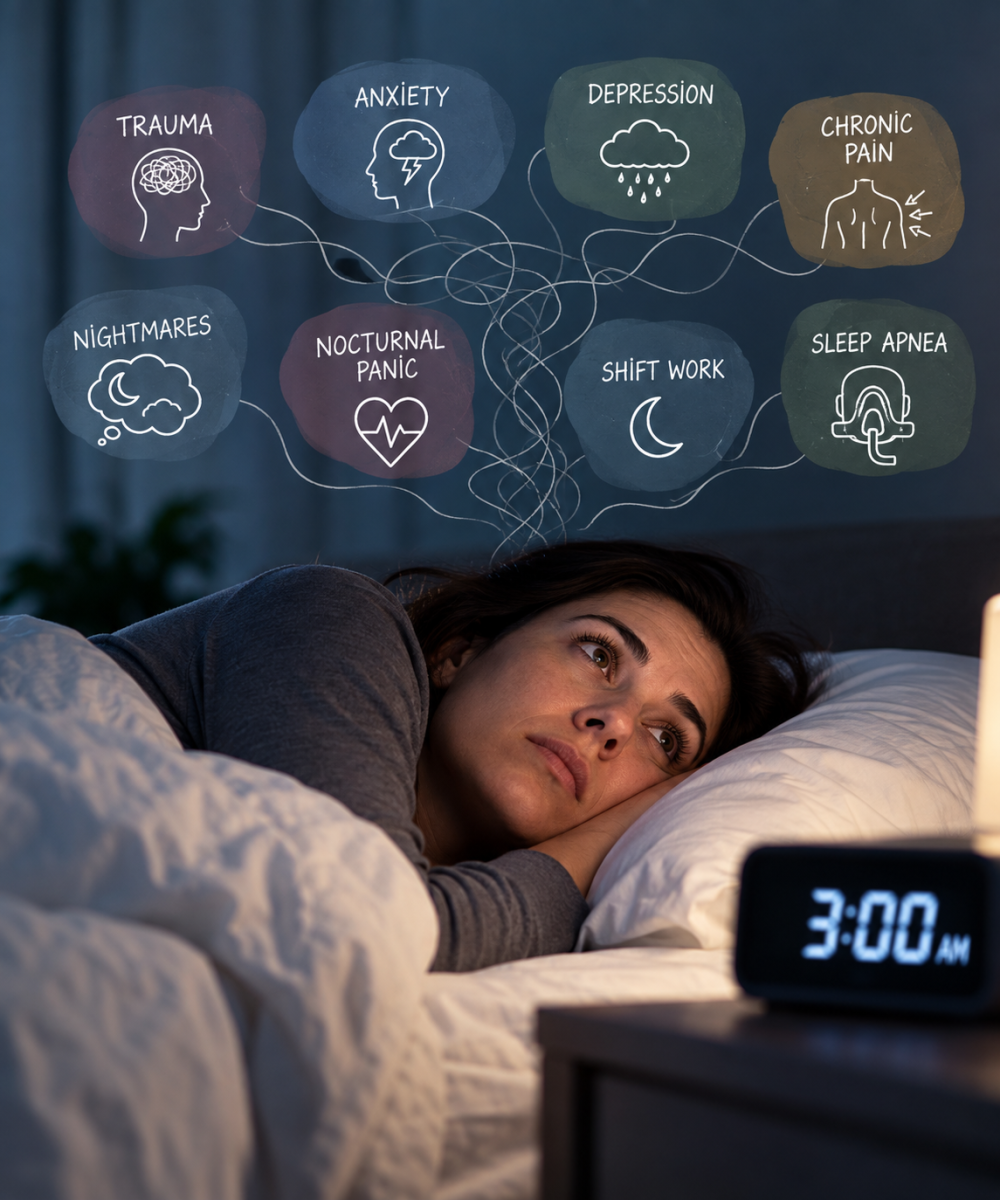
5 Sleep Problems Therapists Often Miss in Complex Cases
A client says they are not sleeping well.
At first, that may sound straightforward. But “poor sleep” can mean very different things depending on what is happening underneath it.
One client may be waking from trauma-related nightmares. Another may be afraid to fall asleep because of nocturnal panic. Someone working rotating shifts may be trying to sleep at a time their body is primed to be awake. Another client may technically have treatment for sleep apnea but cannot tolerate the CPAP mask because it triggers intense claustrophobia.
These are not interchangeable sleep problems, and they do not necessarily respond to the same intervention.
For therapists, the challenge is often figuring out what is actually maintaining the sleep disturbance and how to address it without losing sight of the larger treatment plan.
Here are five sleep presentations that can easily get missed inside more complex clinical cases.
1. Nightmares That Continue After Other Trauma Symptoms Improve
Nightmares are often treated as simply another symptom of trauma.
But what happens when daytime symptoms improve and the client is still repeatedly waking from distressing dreams?
Persistent nightmares can continue to disrupt sleep even when other areas of treatment are moving forward. Clients may begin delaying bedtime, avoiding sleep, or becoming increasingly anxious as evening approaches.
Rather than assuming the nightmares will resolve automatically, therapists can consider interventions that specifically target the nightmare itself.
One approach covered in Dr. Colleen Carney’s upcoming Toronto workshop is Imagery Rescripting and Rehearsal Therapy, which gives clinicians a structured way to work directly with recurring nightmares.
2. Panic Attacks That Happen During Sleep
A client waking suddenly with a racing heart, shortness of breath, sweating, dizziness, or overwhelming fear may understandably conclude that something is terribly wrong.
When these episodes occur during sleep, they can be especially frightening.
Clients may begin monitoring their bodies at bedtime, delaying sleep, or becoming fearful of falling asleep altogether.
Nocturnal panic requires therapists to think beyond standard sleep advice. The sleep disturbance and the panic can begin reinforcing one another, making it important to understand both parts of the cycle.
Dr. Carney’s training will explore cognitive behavioural strategies specifically for nocturnal panic and how they can be integrated into broader anxiety treatment.
3. Insomnia in Clients Working Nights or Rotating Shifts
Traditional advice about maintaining consistent bedtimes and wake times becomes much more complicated when someone’s work schedule changes from week to week.
Nurses, first responders, healthcare professionals, factory workers, hospitality staff, and many others may be expected to sleep at times that do not line up neatly with their internal sleep-wake rhythms.
For these clients, the problem is not simply that they need “better sleep habits.”
Treatment needs to take their actual schedule into account.
Clinicians need strategies that are realistic for people whose work demands may include overnight shifts, early mornings, or rapidly changing schedules.
4. Sleep Apnea Treatment That Triggers Claustrophobia
Sometimes the primary sleep disorder has already been identified.
The client has been diagnosed with sleep apnea. They have been prescribed CPAP therapy. In theory, the treatment plan is already in place.
The problem is that they cannot tolerate the mask.
For clients with claustrophobic responses, trauma histories, panic symptoms, or heightened sensitivity to bodily sensations, putting on a CPAP mask can trigger significant distress.
Simply telling the client that they “need to use it” is unlikely to solve the problem.
Behavioural exposure strategies can help therapists work with the anxiety response while supporting the client’s ability to tolerate their prescribed sleep apnea treatment.
5. Insomnia Embedded in Depression, Anxiety, Trauma, or Chronic Pain
This may be the sleep presentation therapists encounter most often.
The client is not seeking treatment specifically for insomnia. They are coming in for depression, PTSD, generalized anxiety, chronic pain, or another concern — and significant sleep disturbance is woven through the entire picture.
It can be tempting to assume that sleep will improve once the primary diagnosis improves.
Sometimes it does.
Sometimes it does not.
When sleep problems remain untreated, they can become another factor that complicates the client’s functioning and the overall course of therapy.
The goal is not necessarily to separate sleep from everything else. It is to learn how to formulate sleep as part of the larger clinical picture and decide when targeted intervention may be appropriate.
Moving Beyond the Sleep Hygiene Handout
Many therapists were taught a handful of standard recommendations:
- Avoid caffeine late in the day.
- Keep the bedroom dark.
- Turn off screens before bed.
- Maintain a regular sleep schedule.
Those strategies may be useful in some situations, but complex sleep problems often require much more than general sleep hygiene.
Therapists may need to understand when to use behavioural interventions for insomnia, when nightmare treatment is appropriate, how panic interacts with sleep, how shift work changes the clinical picture, and how behavioural strategies can support clients struggling with medical sleep treatments.
That does not mean becoming a sleep specialist.
It means having a broader set of tools when sleep becomes part of the case.
Learn Practical Sleep Interventions With Dr. Colleen Carney
On November 12 and 13, 2026, Dr. Colleen Carney will lead a two-day, in-person workshop in Toronto focused on integrating evidence-based sleep interventions into clinical practice.
Dr. Carney is Director of the Sleep and Depression Laboratory at Toronto Metropolitan University and has extensive experience researching and teaching psychological approaches to insomnia and related sleep concerns.
The workshop will cover practical approaches including:
- Brief Behavioural Therapy for Insomnia (BBTI)
- Cognitive Behavioural Therapy for Insomnia (CBT-I)
- Imagery Rescripting and Rehearsal Therapy for nightmares
- Cognitive behavioural treatment for nocturnal panic
- Exposure strategies for claustrophobic responses to sleep apnea treatment
- Sleep interventions for clients working night or rotating shifts
Through case examples, demonstrations, discussion, and hands-on exercises, participants will learn how to assess sleep concerns, formulate more complex presentations, and integrate sleep-focused strategies into the psychotherapy they are already providing.
Workshop Details
| Dates | November 12 & 13, 2026 |
|---|---|
| Time | 9:00 am – 4:45 pm each day |
| Format | In-person |
| Location | Tartu College Event Space, 3 Madison Ave, Toronto, ON |
| Training hours | 12 hours of direct contact training + Certificate of Participation |
| Early bird rate | CAD $449 (regular $499) — for a limited time |
Expand Your Clinical Toolkit
Sleep problems can look deceptively simple on an intake form.
In practice, nightmares, panic, irregular work schedules, treatment-related anxiety, and insomnia alongside other diagnoses can each require a different clinical approach.
This workshop is designed to help therapists recognize those differences and respond with practical strategies they can integrate into the work they are already doing.
Register for the Sleep Treatment Workshop in Toronto with Dr. Colleen Carney.