


Most professional development gets wedged into the gaps. A webinar between a 2:00 and a 3:00. Notes half-read on a phone. A training that ends at four o’clock and hands you straight back to a full inbox and a client at five.
None of that makes the learning worthless. But it does mean the learning rarely gets the one thing it actually needs, which is room.
Something different becomes possible when you leave the environment where all your other obligations live.
Distraction is not a discipline problem
When clinicians say they struggle to focus during training, they usually describe it as a personal failing. It isn’t. It’s a context problem.
Your ordinary surroundings are dense with cues about everything else that needs you: the file you meant to close, the invoice you meant to send, the room where you’ll be seeing someone in an hour. Those cues don’t stop working just because you’ve opened a training module.
Travelling somewhere else severs that. Not through willpower, but because the cues are simply no longer in the room. What replaces them is the ordinary human capacity to pay attention to one thing at a time — which turns out to be most of what deep learning requires.
Rest is not the opposite of rigour
We tend to file rest and professional development in separate drawers: one is indulgence, the other is work. The learning research doesn’t support that split.
Consolidation — the process by which new material stops being information and starts being knowledge you can actually reach for — happens in the gaps. It happens while you’re walking, or swimming, or doing nothing much at all. Compress the gaps and you don’t get more learning. You get less.
Cancun 2027 is built around that. Workshops run five consecutive mornings, 9:00 a.m. to 12:30 p.m. Afternoons and evenings are yours: the pool, the beach, the surrounding area, a travelling companion, or a long unhurried conversation with a colleague.
The morning-only format isn’t a compromise between learning and holiday. It’s the structure that lets each one do its work.
Five mornings does something a single day cannot
A one-day training gives you one pass at the material. Whatever you didn’t catch, you didn’t catch.
Five mornings gives you something else entirely. An idea introduced on Monday can be sat with, tested against a case you keep thinking about, and brought back on Tuesday as a question. By Thursday you’re not receiving a framework — you’re arguing with it, adapting it, working out where it fits your caseload and where it doesn’t.
That’s the difference between attending a training and actually changing how you practise.
The conversations between the sessions
Ask clinicians what they remember from an in-person training and a surprising amount of it happened outside the room.
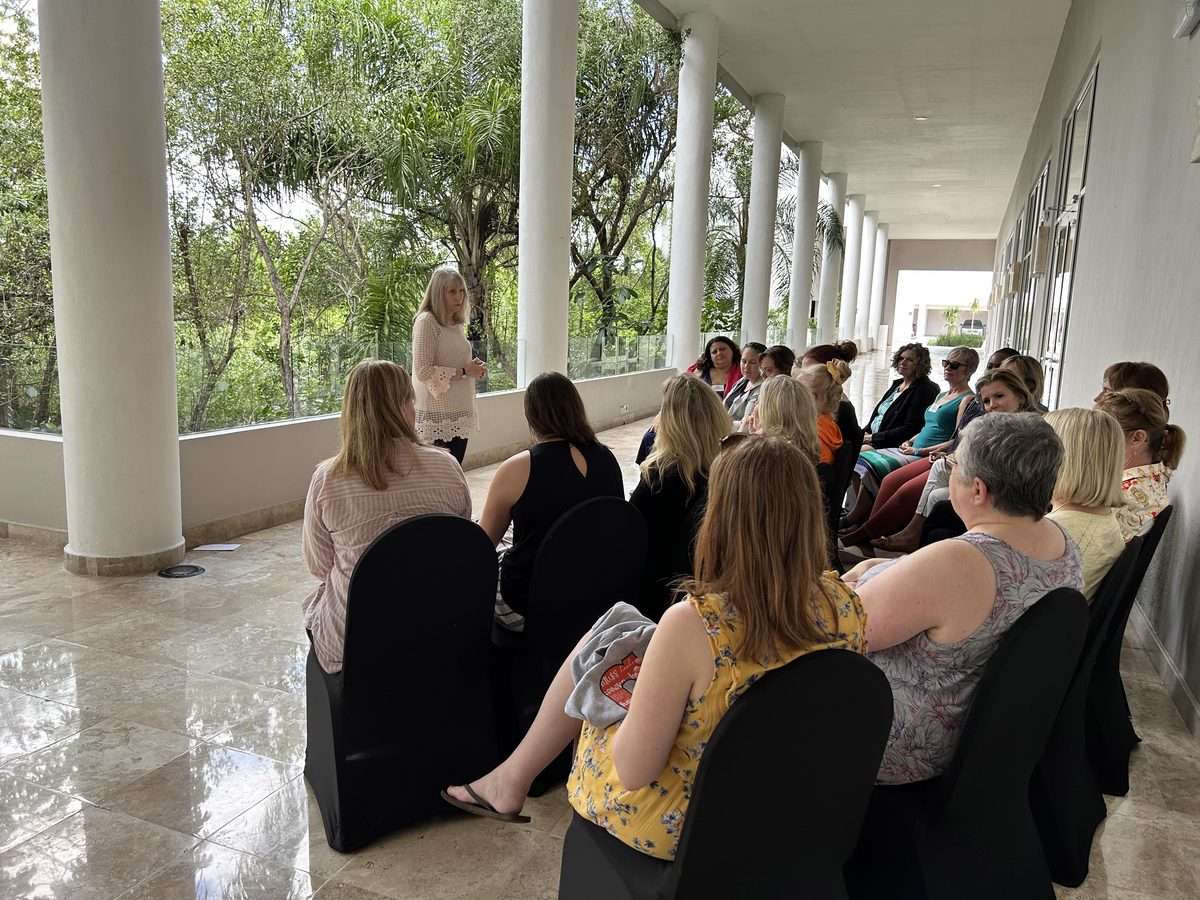
Several days in the same place changes the quality of professional conversation. There’s no rush to a train. Nobody’s watching a clock. You end up talking properly about a case that’s been troubling you, or a referral pathway that works, or the parts of the job nobody puts in a newsletter.
For a profession where a great many people work alone, that matters more than the schedule suggests. Cancun 2027 opens with a Sunday Meet and Mingle so the introductions are already behind you before the first session starts.
A different room produces different thinking
A change of setting doesn’t teach you anything on its own. A beautiful view is not a pedagogical method.
What a new environment does is loosen the grip of habit. Away from the routines that make our assumptions invisible, it becomes easier to notice them — to ask why you’ve always approached something a particular way, and whether you still should.
The setting doesn’t do the work. It creates the conditions in which the work can happen.
Renewal is part of the job
Clinical work asks you to hold other people’s distress, day after day, and to keep doing it with attention and care. That’s meaningful. It’s also depleting in ways that accumulate quietly.
Good professional development gives you more than technique. It can reconnect you with whatever drew you to this work in the first place, and send you home with something to offer rather than something to recover from.
What Cancun 2027 actually looks like
February 1–12, 2027 — Dreams Jade Resort & Spa, Cancun, Mexico
Two consecutive weeks. Each week offers three morning-only, five-day workshops running concurrently — you choose one. Each carries 16.25 CE credits.
Week One — Workshops Mon 1 – Fri 5 February · Resort stay Sat 30 January – Sat 6 February 2027
- The Resilient Body — evidence-based vagus nerve and polyvagal practices for trauma and stress, with Arielle Schwartz
- Narcissistic and Antagonistic Relationship Therapy — a structured clinical framework, with Ramani Durvasula
- Returning to What Matters — an experiential ACT seminar, with Robyn Walser
Week Two — Workshops Mon 8 – Fri 12 February · Resort stay Sat 6 – Sat 13 February 2027
- Working with Dissociation in Therapy — practical, creative and compassionate tools, with Jamie Marich
- Advanced Grief Therapy — a clinician’s toolkit for reconstructing meaning after loss, with Robert Neimeyer & Carolyn Ng
- Advanced Trauma Treatment — integrating neural desensitization, EMDR and somatic approaches, with Jennifer Sweeton
The practical details
- Packages run Saturday to Saturday — seven nights all-inclusive, with one workshop registration built in.
- 16.25 CE credits per workshop.
- Book both weeks together and save $400 per workshop registrant.
- Bring someone. A colleague, partner, friend or family member can share your room and the resort without attending a workshop.
- Looking for a roommate? Travelling solo but would prefer the double-occupancy rate? Let us know, and we’ll do our best to match you with another solo traveler.
- Early Bird rooms are limited, and prices are in USD unless otherwise noted.
Not sure which workshop is right for you?
We host free 30-minute Zoom conversations with each presenter. You’ll hear about the workshop in their own words and can put questions to them directly in a live Q&A.
Cancun 2027 February 1–12, 2027 |
The most useful learning tends to arrive when there’s enough room to notice it.
Top 10 questions about Cancun 2027 — dates, cost, CE credits and cancellation, answered →