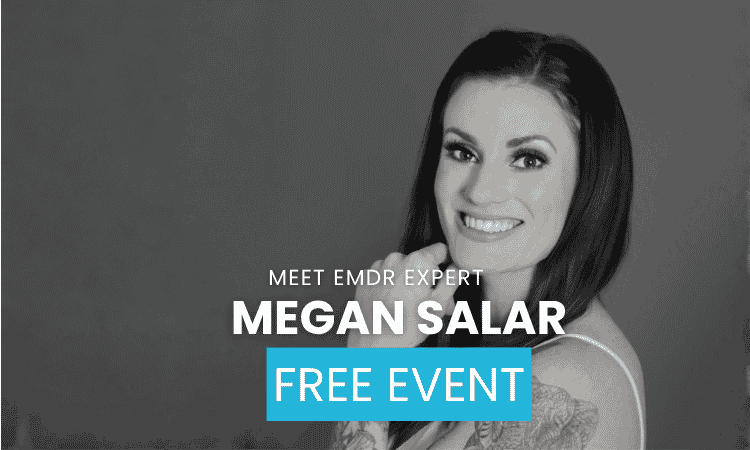
One-on-One with Megan Salar

The event is expired

One-on-One with Megan Salar

Free Virtual Chat with Megan Salar, MSW | Wednesday, September 9, 2026 | 12:00 - 1:00 pm ET

A Free, Live Virtual Conversation on EMDR, Complex Trauma, and Advanced Clinical Practice

Working with complex trauma can challenge even experienced EMDR clinicians. Clients may become overwhelmed, disconnected, or stuck during reprocessing, and standard EMDR protocols may not fully address chronic dysregulation, dissociation, attachment wounds, and deeply established protective responses.

Join Michael Kerman, President of Leading Edge Seminars, for a free, live conversation with Megan Salar, MSW, an EMDR clinician, trainer, consultant, and author known for making advanced trauma concepts practical and accessible.

During this One-on-One conversation, Michael and Megan will explore why complex trauma requires a more nuanced and flexible approach to EMDR, how clinicians can better understand blocked or looping processing, and what therapists can do when a client’s nervous system or protective parts interfere with treatment.

These free One-on-One events help therapists meet the speaker, learn about their perspective, and better understand their approach before committing to a paid training.

The conversation will also offer an early preview of Megan’s upcoming webinar, Advanced EMDR Strategies for Complex Trauma: Somatic and Ego State Approaches, taking place September 24–25, 2026. The webinar will explore how clinicians can incorporate somatic awareness, ego state conceptualization, and modified EMDR strategies into complex trauma treatment.

Learn more about Megan Salar.

Get to Know Megan Salar

Megan Salar’s work focuses on helping clinicians use EMDR with greater confidence, flexibility, and sensitivity when working with complex trauma.

Her approach brings together EMDR, attachment theory, dissociation, nervous-system regulation, and ego state work. Rather than treating stalled processing as resistance or failure, Megan helps therapists become curious about the survival responses and protective strategies that may be shaping the client’s experience.

During this One-on-One conversation, Michael will explore Megan’s professional journey and the experiences that have shaped her approach. Megan will discuss:

  • What initially drew her to EMDR and complex trauma treatment
  • How attachment, dissociation, and nervous-system regulation inform her clinical work
  • The teachers and influences that shaped her development as an EMDR clinician
  • What she has learned from supervising and consulting with other therapists
  • Common misconceptions about using EMDR with complex trauma

Megan’s practical and reassuring teaching style helps clinicians recognize that complexity does not necessarily mean treatment has failed. It often means the client needs a more carefully paced, individualized, and trauma-responsive approach.

Exploring Megan’s Work and Approach

Many clinicians complete EMDR basic training feeling prepared to begin reprocessing traumatic memories. However, complex and developmental trauma can introduce additional challenges that may not be fully addressed by standard protocols.

Clients may experience chronic dysregulation, dissociation, emotional shutdown, rapid flooding, looping, blocked processing, or strong protective responses. Megan’s work helps clinicians understand what may be happening beneath these presentations and respond with greater clarity.

In this portion of the conversation, Michael and Megan will explore:

  • Why complex and developmental trauma can require a different approach from single-incident trauma
  • How clinicians can assess whether a client is ready for reprocessing
  • What stalled or blocked processing may be communicating
  • How attachment wounds and protective parts can influence EMDR treatment
  • The role of somatic awareness in identifying activation, shutdown, and disconnection
  • How clinicians can distinguish resistance from adaptive protection
  • Ways therapists can remain grounded and confident when sessions do not unfold as expected

Megan will also share clinical examples that illustrate how slowing down, listening to the nervous system, and adapting the protocol can help treatment move forward safely.

Sneak Peek at Megan’s Upcoming Webinar

In the final part of the conversation, Michael will guide the discussion toward Megan’s upcoming webinar, Advanced EMDR Strategies for Complex Trauma: Somatic and Ego State Approaches.

The two-part webinar is designed for experienced EMDR clinicians who want to strengthen their clinical decision-making and expand their ability to work with complex trauma presentations.

Michael and Megan will discuss:

  • How somatic and ego state indicators can interfere with standard EMDR reprocessing
  • How clinicians can differentiate trauma activation, ego state interference, and adaptive protective strategies
  • Ways to integrate somatic awareness and ego state interventions throughout the eight phases of EMDR
  • How titration and restricted processing can help clients remain within a manageable range of activation
  • The use of targeted interweaves when processing becomes blocked or repetitive
  • How to adapt EMDR for clients who become highly activated, shut down, or dissociative
  • Strategies for strengthening case conceptualization and treatment planning
  • Ways to reduce treatment stagnation while maintaining safety and therapeutic engagement

Megan will also discuss how advanced EMDR skills can support therapists themselves by reducing uncertainty, frustration, and burnout when working with complex cases. The webinar uses real-world clinical examples and practical strategies that participants can bring directly into their work.

Learn more about Advanced EMDR Strategies for Complex Trauma with Megan Salar.

Get your free ticket

Space is limited for One-on-One with Megan Salar—registration is required to attend this free event.

Just click GET A FREE TICKET below.

Register Event Free

I have read and agree to the website terms and conditions

Event Detail

September 9, 2026 12:00 pm
September 9, 2026 1:00 pm
Online

Who Should Attend

  • Marriage and Family Therapists
  • Clinical and Counselling Psychologists
  • Social Workers
  • Psychiatric Social Workers
  • Pastoral Counsellors
  • Psychotherapists
  • Psychiatrists
  • Physicians
  • Nurse Practitioners
  • Occupational Therapists
  • Counsellors
  • Graduate Students in accredited programs in the above fields
  • Case Managers
  • Licensed Professional Counsellors
  • All other professionals who would like to develop, update, or expand their skills and knowledge in mental health practices